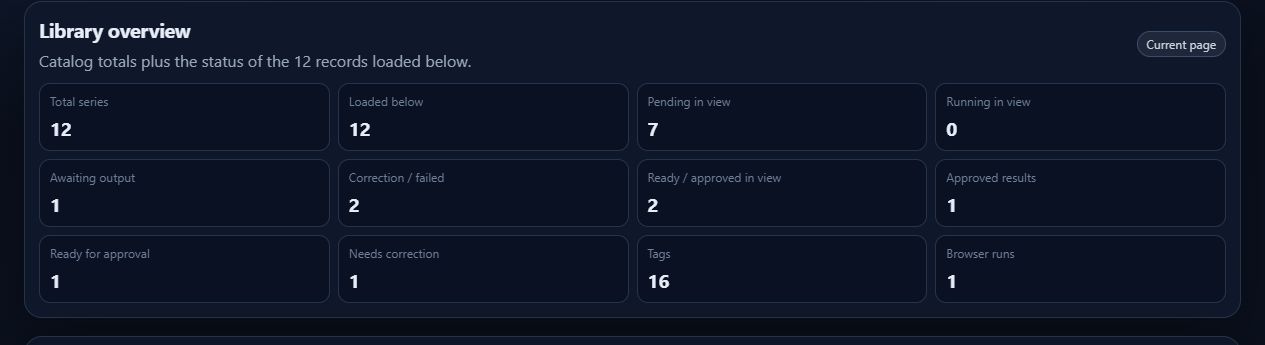
Visible workflow state
Pending, correction, ready-for-approval, and approved are different product states—not one success counter.
Source-free engineering case study · private alpha.24
A Windows desktop workflow for bilingual short-drama catalog enrichment. It protects the source SQLite database, keeps ChatGPT inside one application window, monitors live response state, stages validated drafts, and requires explicit approval before any result becomes exportable.
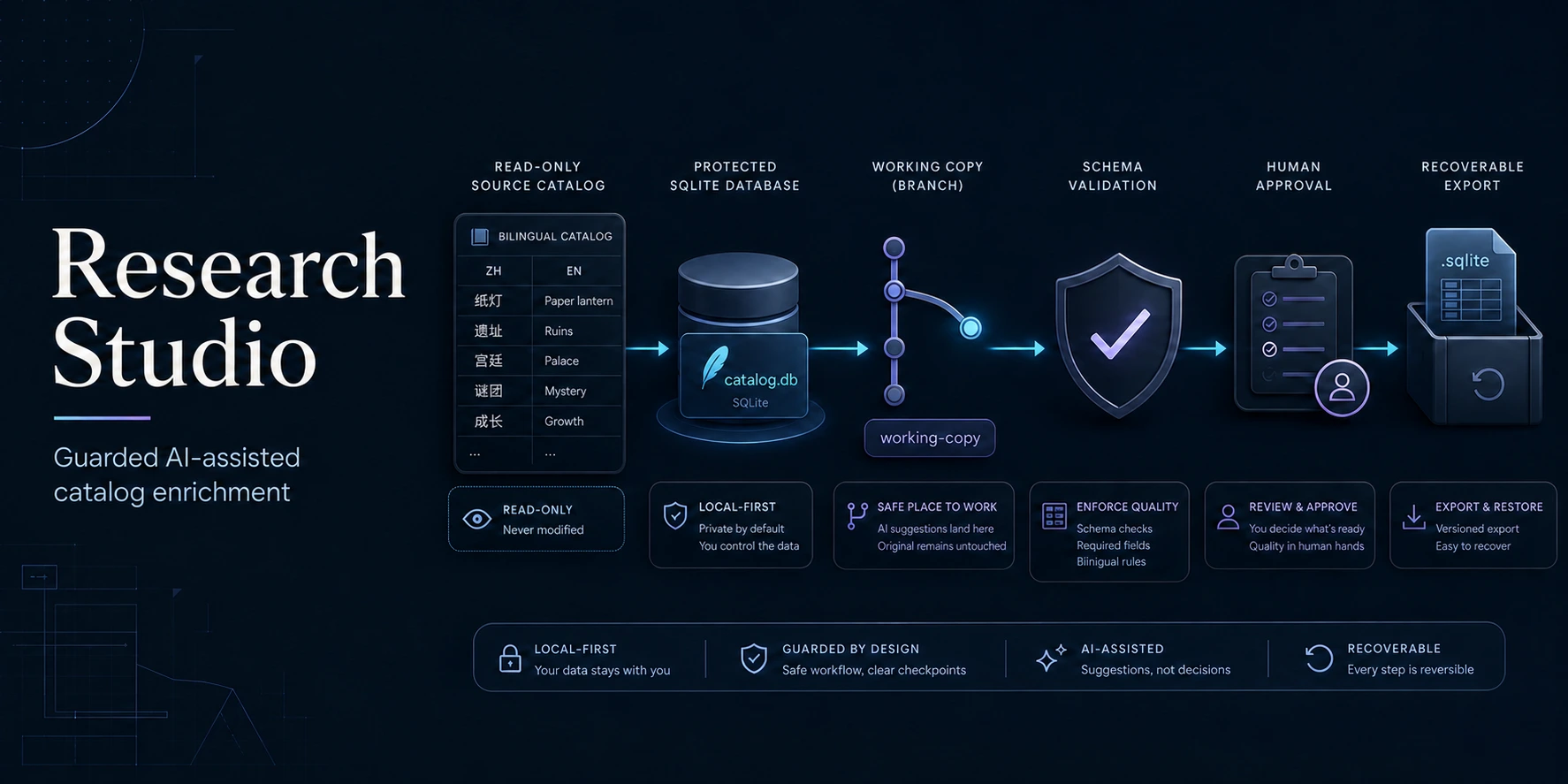
Original conceptual illustration · no private catalog or account data
Product tour · deterministic synthetic catalog
Every title, description, identifier, result, and count below is fabricated. The captures exclude the browser/account pane and machine paths.
Pending, correction, ready-for-approval, and approved are different product states—not one success counter.
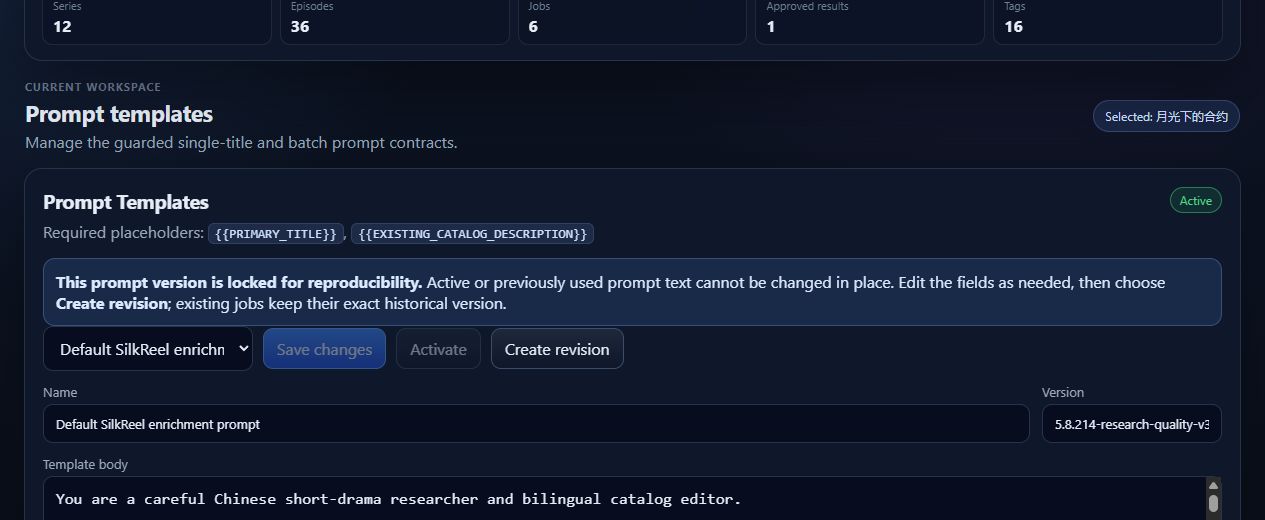
Active or used prompts are immutable. Revisions preserve the exact contract attached to historical jobs.
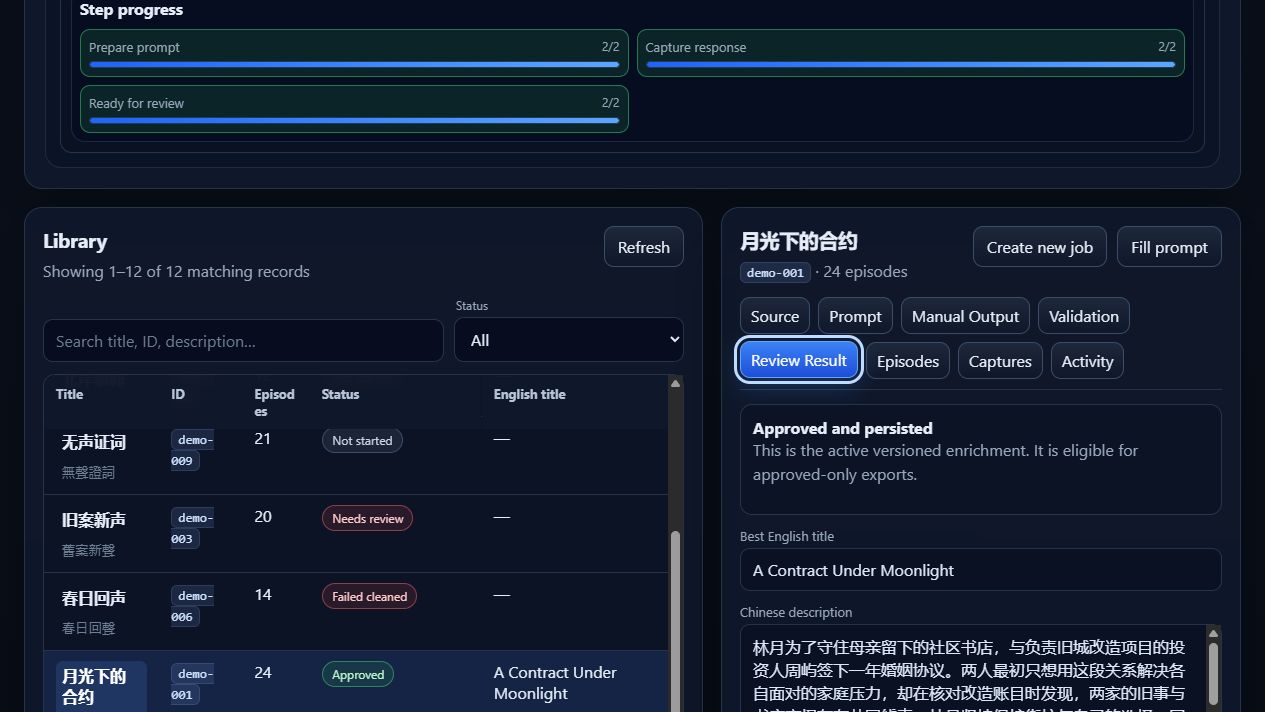
A valid capture is only a staged job draft. Approval revalidates it and creates the immutable result version.
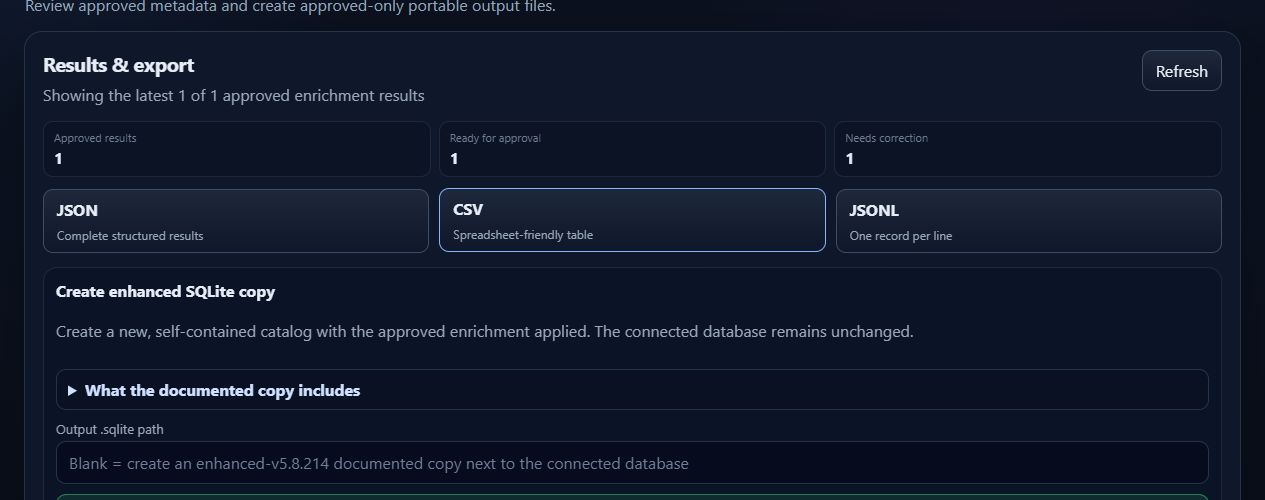
Every format shares one eligibility rule, so staged or correction records cannot escape through another route.
Authority map
No schema or enrichment write
No file, database, approval, or export authority
Only this transition creates a result version
Prior build remains recoverable until verification passes
Evidence-first prompt v3
The prompt treats catalog text as untrusted, requests title-plus-premise matching, falls back conservatively when identity is uncertain, and forbids unsupported cast, platform, episode, ending, supernatural, pregnancy, and identity-twist claims. ChatGPT returns canonical tag IDs; Research Studio derives the Chinese and English labels locally.
Review the prompt contractPackaging is executable evidence
Types, lint, formatting, tests, prompt evals, build, and dependency audit.
Rebuild for Electron ABI 146, query SQLite, then restore Node ABI 137.
Bundled React over an application-private named pipe—not an external dev server.
Preserve durable data only; restore the prior build after injected failure.
Ownership and limits
I owned product direction, extraction architecture, database and browser safety, prompt/evaluation strategy, human-approval design, QA criteria, licensing boundary, technical review, and release approval. AI agents assisted with research, implementation, and iteration; their output was reviewed and verified.
The application remains private. The case study does not claim public distribution rights, code signing, universal model accuracy, provider-policy approval, or production readiness. Research Studio was extracted from a module in SilkReel Windows 5.8.214; I do not claim authorship of the entire upstream product.
Follow the bounded evidence